Durable AI teams for Codex and Claude
Turn ad-hoc subagents into durable, accountable AI teams.
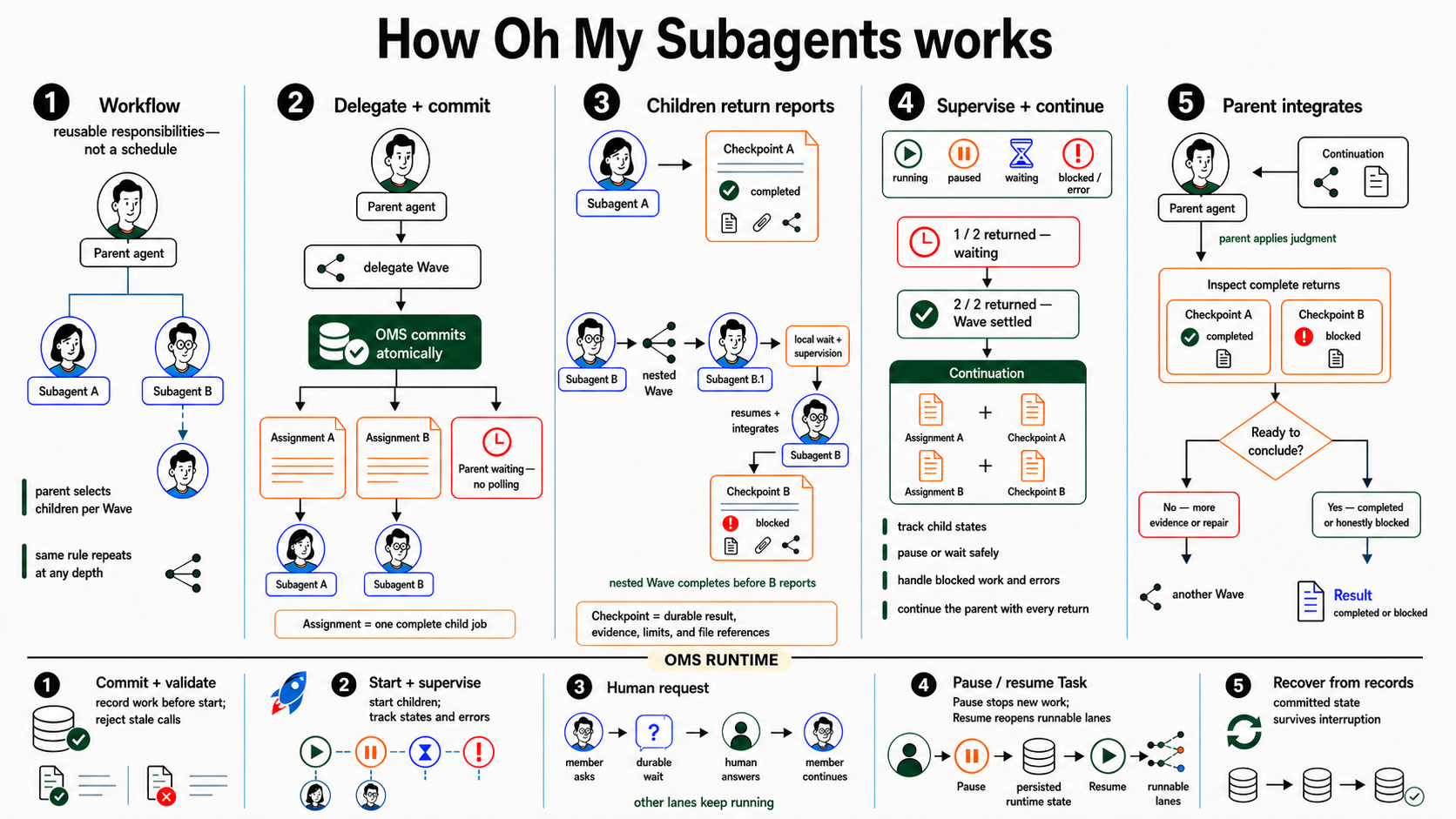
Oh My Subagents is a local runtime for subagent orchestration with Codex and Claude. Build a reusable team, give its lead one concrete mission, and follow the work in a visual Console. The controller records delegation, waits, returned evidence, and one completed or blocked Result.
Install and run your first team Explore the source
Start with your provider
- Run a Codex agent team — configure Codex, start a coding mission, and inspect the returned work.
- Run a Claude agent team — configure Claude, check sandbox prerequisites, and start a research or coding team.
- Use independent code review — separate implementation, review, repair, and integrated verification.
- Recover interrupted agent work — inspect the original run and continue from committed controller state.
Why Oh My Subagents
- Reuse explicit responsibility trees instead of recreating roles and prompts for every job.
- Delegate without polling while the runtime commits Assignments, persists waits, supervises returns, and continues the parent.
- Recover from committed state after a provider interruption, browser closure, or controller restart.
- Return one accountable Result after the Task lead inspects the team's Checkpoints, evidence, and referenced files.
Watch the Console tutorial to see the product in use.
Install locally
For a fresh installation with Python 3.12 or newer:
Open http://127.0.0.1:18125/. Linux, macOS 13+, and Windows 11 x64 are supported; SQLite is the default. The installation guide covers provider authentication, platform requirements, and existing installations.
Start here
- Getting started — install Oh My Subagents, configure a provider, and complete a first developer or researcher run.
- Starter team catalog — choose among the eight installed Workflows using realistic missions and expected deliverables.
Understand the product
- Workflows and teams — understand responsibility trees, Members, providers, capabilities, and adaptive work.
- Runtime and Results — understand Tasks, Assignments, Checkpoints, and the lead's final Result.
- Workspace and files — understand the shared workspace, loose file references, notes, and deliverables.
Build and run teams
- Author a Workflow — start from a Starter, shape responsibilities in Workflow Studio or with the Operator, validate, and publish.
- Run and operate — start work, read the run view, respond to allowed waits, and use legal controls.
- Console and Operator — visually edit and publish teams, inspect live work and Results, or use the separate conversational Operator for the same product operations.
- Migrate from Banksia — copy an existing installation into canonical OMS state.
Configure and integrate
- Configuration reference — configure SQLite or PostgreSQL, providers, workspace defaults, sandboxing, and Operator.
- Workflow definition reference — use the public JSON/YAML schema and field contract.
- CLI reference — automate local setup and product operations.
- HTTP API — integrate through the loopback product API.
- Controller tools — understand the exact Task-member and Operator tool surfaces.
Fix a problem
- Troubleshooting — diagnose initialization, database, provider, controller, Workflow, and recovery problems.
- Report an issue — include the smallest redacted evidence that reproduces the problem.
Contribute
- Contributing — prepare a source checkout, follow repository owners, work in a bounded slice, and report executable proof.
- Maintainer verification — run the repository's quality, contract, and release-readiness checks.
Project and licensing
Oh My Subagents is maintained by Leo Zhang and contributors. The core is MIT licensed. The visual Console contains n8n-derived material and uses the Sustainable Use License; see its attribution notice.